- Great News Day
- Posts
- Great News Day: October 11, 2026
Great News Day: October 11, 2026
In partnership with

Silver Miners Have Outrun Silver Since 2020

Since March 2020, silver has returned about 402%. The silver miners returned 445%.
That gap is the leverage our research team focuses on. When silver rises, a producer's net asset value can rise much faster, and share prices tend to follow. It works in both directions, and a mine is only as good as the company running it.
The Ultimate Silver Playbook shows how the team separates the miners worth owning from the rest, and which silver stocks are on its watchlist now. It's free.
Good morning. Pour something warm. The world has quietly been doing some beautiful things while nobody was looking, and we found five of them for you. Also an origami crane that kept a secret for ten years.
🌱 Today's Mindset
The thing you started is still counting
There is a quiet kind of math most of us never bother to run.
You did something small, years ago. You helped a neighbor move. You wrote a note that mattered more than you knew. You planted something. You said one kind sentence to a child who was having a very bad afternoon. And then you forgot about it, because life moves on, because the next thing was already asking for you.
But the thing you did did not forget. It kept going. Sometimes it just quietly held its shape, waiting to be rediscovered. Sometimes it grew roots. Sometimes it grew wings.
The world we are living in right now was partly built out of favors we don't remember doing and gifts we didn't know we were receiving. The teacher who stayed an extra ten minutes. The stranger who held the door. The grandparent who said one true thing. Those tiny deposits keep paying out, in people we may never meet, in moments we will never see.
Today's issue has a lot of this in it. A tiny shorebird that was down to twelve breeding pairs is up to ninety nine, because people showed up to count eggs for forty years. A retired teacher in California is gently handing out ten thousand oak seedlings, each one a tree his great grandchildren might sit under. A paper crane folded for a scared child in Japan carried a message she would not read for a decade.
You will not get a receipt for most of the good you do. The receipt is the world, and it arrives late, and it arrives somewhere else, and that is still a yes.
So keep going. The thing you started is still counting.
⭐ Today's Bright Lead
A dozen pairs, then ninety nine. The piping plovers are winning.
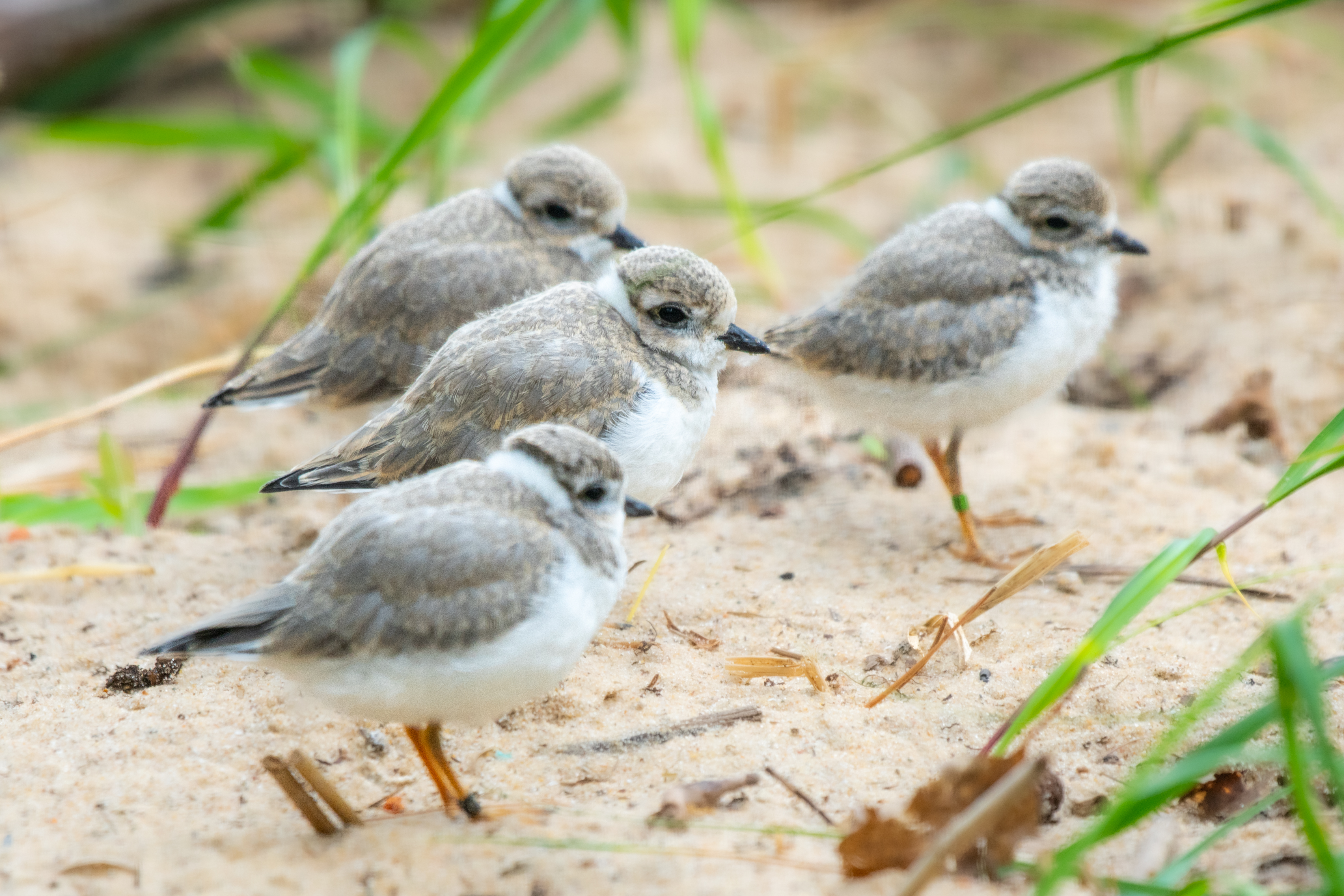
A Great Lakes piping plover. Photo via Michigan Public / University of Michigan Biological Station.
A few decades ago, you could have fit every nesting Great Lakes piping plover into one small corner of northern Michigan. Twelve breeding pairs. That was it.
This week, Audubon announced the count for the 2026 breeding season. Ninety nine pairs. A record 184 chicks fledged. The fifth consecutive year of population records. The highest total since the tiny shorebird was first listed under the Endangered Species Act in 1986.
A single number does not capture how improbable this is. Piping plovers are the size of a tennis ball. They nest in the open, on beaches people love walking on. Their eggs are the color of pebbles. Both parents share incubation, which sounds romantic until a storm sweeps through and one of them does not come back. For most of modern memory, their story was a quiet slide toward goodbye.
Then forty years of stubborn, careful people pushed back. Volunteers put up string fencing around nests. Field teams rushed abandoned eggs to the captive rearing center at the University of Michigan Biological Station in Pellston, where thirteen zoos helped hatch and raise 24 chicks that would otherwise never have made it. Beaches were partially closed during the delicate weeks. Predators were managed. Habitat was restored.
The most beautiful line in the whole report sits halfway down the page. On Cat Island in lower Green Bay, Wisconsin, piping plovers nested for the first time in seventy five years. Seventy five years. People restored the island shoreline, and the plovers came back. Two broods. Five chicks.
Plovers nested on all five Great Lakes this year, something that has only been true since 2017. The recovery target is 150 pairs. They are at 99 and climbing.
A tiny bird, a long patience, a very good season.
🌍 More Good Today
Ten thousand acorns, one retired teacher, a lot of future shade · CALIFORNIA
Jim Crouch spent his career teaching science to kids in San Diego County. He retired, started raising oak seedlings in his backyard, and when he had too many, he started giving them away.
Fifteen years later, his group Re-Oak California has distributed about 10,000 young native oaks across Southern California, with volunteer run nurseries now opening in La Cañada, Santa Clarita, and soon Irvine. The newest site is aimed at Altadena, where last winter's Eaton Fire took out roughly seventy percent of west Altadena's tree canopy.
Each seedling Crouch hands out is about six inches tall. The person who plants it may wait more than ten years for shade. He is seventy five now, uses a cane, and keeps going. Read more.
An ibis that was extinct in the wild just flew three hundred kilometers from home · JAPAN
Japan's crested ibis went extinct in the wild in 2003. In 2008, using a pair of birds donated by China, a reintroduction program began on Sado Island, off the Sea of Japan coast of Niigata Prefecture.
This week, Japan's Environment Ministry confirmed that one of those ibises was spotted more than 300 kilometers from Sado, in rice paddies in Shiga Prefecture, western Japan. First a Takashima resident saw it foraging in June. Then four more sightings in August. Same bird. It had traveled further from the release site than any crested ibis before it.
Ministry rangers are gently asking people to let it be and let it settle. A national treasure, decades gone, has decided to go exploring. Read more.
Barrydale asked for 86,000 rand. The world sent nearly triple. · SOUTH AFRICA
In the small Klein Karoo town of Barrydale, South Africa, a food garden project called Love in a Bowl grows organic vegetables for people who need them. Two years ago it was one circle of vegetables on borrowed land. Today it supplies eight community kitchens that feed about 380 people a week, young and old, nobody left out.
In late September, founder Gordon Aeschliman asked for R86,000 to prepare new land, lay irrigation, and plant thousands of seedlings. By October 6, local and global donors had sent in R244,584, nearly triple the goal. Four new vegetable circles are being prepared now, with potatoes, pumpkins, and squash on the way. The expanded garden will feed more than 1,000. Read more.
🔬 Science of Joy
Stanford turned a cancer's own survival trick against it. In mice, the tumors vanished in eleven days.
A team at Stanford Medicine has done something that sounds almost impossible. They built a molecule that takes one of lymphoma's favorite survival tools and reprograms it into a self destruct button.
The protein in question is BCL6. In many aggressive B cell lymphomas, BCL6 keeps damaged cells alive by silencing the genes that would normally tell them to stop or die. Instead of just blocking BCL6 the usual way, the Stanford researchers designed a two part chemical bridge called TCIP3. One end grabs BCL6. The other end drags in enzymes that chemically tag it, loosening the DNA around it and switching on the exact genes BCL6 was holding shut, including the ones that trigger cell death.
In lab dishes, TCIP3 killed lymphoma cells at tiny concentrations. In mice carrying implanted human tumors, the tumors vanished within eleven days of twice daily dosing. The mice showed no obvious toxicity and no spike in inflammation.
This is still mouse work. TCIP3 needs more chemistry, more animal studies, and eventually human trials before anyone can call it a treatment. But the strategy itself, chemically forcing a cancer driver to do the opposite of its job, is new, and the Stanford team thinks the same tactic could reach other diseases where similar machinery misbehaves. Read more.
💛 Bright Find
This spot is open today, and we're picky about it.
Great News Day gets opened by people who are tired of being yelled at by their inbox. If your product belongs in a quietly good morning, a thoughtful book, a small coffee roaster, a tool that gives time back, a cause worth loving, this is where it goes.
Reply to this email and tell us what you make.
✨ One More Smile
An origami crane kept a secret for a decade
When Rika Matsuda was seven, in Japan, her new bike had bad brakes and sent her straight into a wall. A kind stranger in a suit helped her up, washed the cut on her foot, lent her his phone to call her grandfather, and folded her a small paper crane while they waited. He handed her the crane without a word and disappeared. She kept it on her desk for ten years.
A few weeks ago, in her English class in Seattle, her teacher assigned a workshop built around KUOW's "My Unsung Hero" series. Matsuda remembered the crane. She went home, carefully unfolded it, and found two characters written on the inside of the paper.
An old Japanese idiom. In English: cherish the moment.
Via Good News Network, originally reported by KUOW.
Here's to the thing you did ten years ago that is still working.
See you tomorrow.
Great News Day
Share with a friend · Unsubscribe
Reply