- Great News Day
- Posts
- Great News Day: November 22, 2026
Great News Day: November 22, 2026
Two strangers waded into waist deep mud for a cat named Cosmo. Plus four cheetah cubs in India, a takahe chick nobody expected, and a malaria vaccine that just worked at 87%.
In partnership with

Self-care in 10 minutes a day, now 25% off

Looking for an easy way to elevate your daily skincare routine? Meet the BON CHARGE Red Light Face Mask.
Designed with optimal wavelengths of 630nm red light and 850nm near infrared light, it's a simple addition to your routine to support more radiant, glowing skin. Suitable for all skin types, the lightweight mask contours comfortably to your face and can be used for just 10 minutes a day. Whether you're reading a book, winding down at home or packing for your next trip, it's an effortless way to prioritise a little self-care. BON CHARGE combines innovative wellness technology with science-backed research to create premium products that make looking after yourself easier.
Shop the BON CHARGE Black Friday Sale and enjoy 25% off sitewide. Click the link to explore the range, with your discount automatically applied
Sunday, November 22, 2026
Good morning, friends. Today's letter is about small, well-aimed effort. A guy scrolling Facebook with a drink in his hand. A bike volunteer pedaling the same route again. A cheetah, settled in her new country. A tiny bird that hatched in a place no one expected. And a vaccine three decades in the making that just worked on one of the hardest diseases on Earth. Pour the coffee. There is a lot of good to notice.
🌱 TODAY'S MINDSET
The one minute that becomes somebody's whole week
Most of the good in the world moves through doors that are only open for about a minute.
A friend texts. A stranger scrolls past a plea on Facebook. A nurse walks into the right room at the right time. A neighbor looks up from the mail. In each case, the door is small and the window is short. A minute later, the scroll keeps going, the nurse heads to lunch, the neighbor closes the lid on the box. The moment closes behind them, quietly, and nobody keeps score.
Here is what most people miss about those minutes: on the other side of the door, somebody has been waiting a very long time.
Joleen Porter in Colorado spent a whole night awake, picturing her cat Cosmo alone in a flooded mobile home. She was not thinking in minutes. She was thinking in hours and miles. And then a roofer named Edward Breyette, pouring himself a drink at the end of his shift, scrolled past a Facebook post. For him, that was one minute. For her, it turned out to be the whole week. Maybe the whole year.
You know what this says about you? It says the minute you were tempted to call too small, too random, too unlikely to matter, might be arriving at exactly the right moment on somebody else's clock. You cannot see the clock. That is the honest part. But it is almost always ticking.
So when the small nudge comes today, and it will, take it. Reply to the text. Say yes to the request. Walk across the parking lot. Pick up the phone. You will not know, standing in your minute, what size it is on the other side.
A minute of yours can hold someone else's whole week. And now you'll feel it the moment it arrives.
⭐ TODAY'S BRIGHT LEAD
A Facebook scroll, a Hummer, and a cat named Cosmo
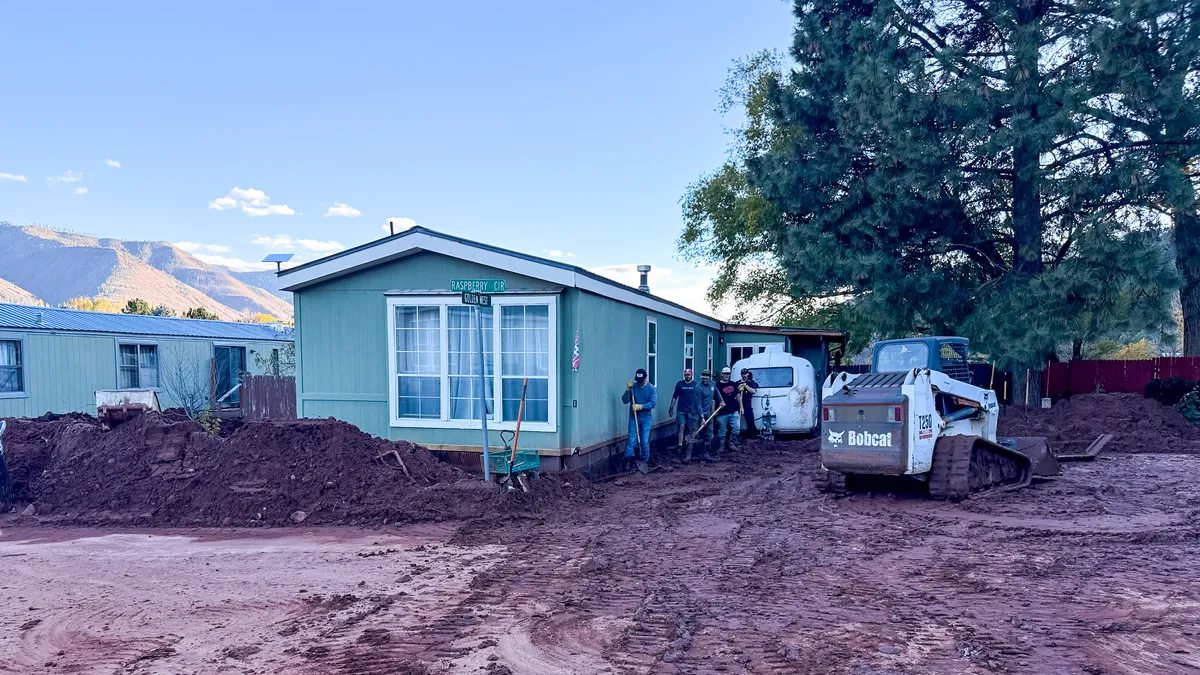
Photo: Rocky Mountain PBS
When the Nov. 1 flood tore through Durango North Village, Joleen Porter had five minutes to evacuate. She grabbed her medications, her documents, and a change of clothes. The sheriff's deputy at the shelter would not let her bring her ten year old cat Cosmo inside, so she had to leave him in the mobile home. She spent that night staring at a ceiling that was not hers, picturing an empty food bowl.
The next day she called 211. They could not help. A friend suggested she post on a local Facebook group. She did.
Edward Breyette, a Durango roofer, had just gotten home from work. He poured a drink, sat down, opened Facebook, and Porter's plea was the first post he saw. "I was like, oh, wow," he told Rocky Mountain PBS. "I said, 'Hey, I'll get your cat.'"
Ten minutes later he was at her door with a Hummer. Another stranger named Jason Michaud had answered the same post and showed up too. The road into the neighborhood had become a riverbed of mud, rocks, railroad ties, and submerged debris. Breyette and Michaud waded through waist deep water to the front door. Michaud lost his phone to the flood on the way in.
Inside the house, somehow, was dry. The power was out. They found Cosmo under a bed by the light of a cigarette lighter. Thirty minutes after they arrived, the cat was in a carrier, back across the mud, safe.
Two strangers, one cat, one night of worry ended. More than 4,500 people were evacuated in La Plata County. Volunteers kept showing up for weeks afterward with shovels, skid steers, food, and more Facebook posts. Breyette has since used his roofing equipment to clear mud from other people's properties.
"I was just so amazed," Porter said, "that somebody would be willing to take a chance and do anything like this to help me."
Read the full story at Rocky Mountain PBS →
🌍 MORE GOOD TODAY
Seattle's food bank gets a bicycle delivery service, and it just hit two million pounds
Since the pandemic, volunteers with the Cascade Bicycle Club's Pedaling Relief Project have been loading cargo trailers onto their bikes, rolling up to Seattle grocery stores and farmers markets, and hauling rescued food directly to food banks and to the doors of people who need home delivery. This month they crossed a quiet milestone: two million pounds of food and essential goods delivered, over more than 100,000 miles pedaled and roughly 3,400 rides. Forty thousand households have been served. No trucks. No emissions. Just a growing posse of people who keep showing up for the same route every week. Axios Seattle has the numbers.
A Botswana born cheetah just had four cubs in India, in the open
In 2022, India began reintroducing cheetahs to the wild after the species had been declared locally extinct in 1952. On Friday, a two and a half year old female known as KOMG 3, flown in from Botswana last year, gave birth to four healthy cubs in Kuno National Park. She is the first Botswana born female to deliver in India, and she did it under fully natural conditions after more than four months loose in the park. The country's wild cheetah count is now 62, including 43 born in India. "Every such birth strengthens our hope," said the environment minister. For a species that vanished from a continent and is being carefully coaxed back, four new cubs in the grass is a very big weekend. Official announcement here.
A takahē chick hatched on the far tip of New Zealand, in a place they'd never nested before
Eight takahē, one of the rarest flightless birds on Earth, were released in May at Onetahua, also known as Farewell Spit, a hook of sand at the top of New Zealand's South Island. Two of them, who had arrived from separate groups and were not a breeding pair when they landed, found each other, settled in, and this month hatched the first chick ever recorded at the site. The surrounding four kilometer predator proof fence, built just before the release, now protects about 2,000 hectares around a single tiny bird that nobody predicted. Decades of patient trapping, two birds who decided to pair up, one fence, one chick. That is how a species comes back. Department of Conservation has the details.
🔬 SCIENCE OF JOY
After three decades of trying, an 87% effective malaria vaccine
Malaria kills more than 600,000 people a year, most of them children. The vaccines that exist today reduce how sick a kid gets. They do not block infection. What scientists have been chasing for thirty years is a vaccine that stops the parasite at the door.
This week, at the annual meeting of the American Society of Tropical Medicine and Hygiene outside Washington, D.C., a team led by UW Medicine, Fred Hutch, and Seattle Children's reported that their new PfSPZ LARC2 vaccine did exactly that in a phase 1 trial. Twenty two volunteers were deliberately exposed to live malaria parasites three to four months after their last dose. All seven unvaccinated volunteers got infected. Of the fifteen vaccinated, only two did. That is 87% efficacy, and it held up even though the challenge parasite was a Brazilian strain while the vaccine was built from a West African one, which matters enormously, because malaria is not the same parasite everywhere it lives.
The vaccine uses a whole, live malaria parasite that has been genetically edited to grow normally in the body up to a point and then safely stop. The immune system gets a long, close look at the real enemy, and learns how to shut it down. Larger trials are the next step. But a tool that completely blocks infection, that works across strains, is the exact tool the field has been waiting for.
Read the UW Medicine announcement →
💛 BRIGHT FIND
Sponsor slot. Always labeled, always in voice.
This spot is open, and we're picky about it. If you run something that makes your corner of the world a little warmer, a little healthier, or a little more useful... we'd love to feature it here.
Reply to this email and tell us what you do and who it serves. If it fits, we'll send over rates and our (short) list of standards.
✨ ONE MORE SMILE
The puppy who picked her own human
Roman Letsis, an 18 year old car salesman at a dealership in Wichita Falls, Texas, was sitting at his desk with a customer when a dirty Great Pyrenees puppy wandered in through the open door. She crossed the showroom, trotted straight to his chair, and hopped into his lap. Nobody had seen her before. She spent the rest of his shift lounging next to him like she worked there. By the end of the day, a stray with a very specific preference had a home, a bath, and a human. Sometimes the universe sends the application in person.
The Washington Post has the picture →
See you tomorrow.
Take the minute today. Somebody on the other side has been waiting.
The Great News Day team
Reply