- Great News Day
- Posts
- Great News Day: November 15, 2026
Great News Day: November 15, 2026
Two teenage brothers, one paddleboard, and a flooded neighborhood they would not leave behind.
In partnership with

Want to get the most out of ChatGPT?

ChatGPT is a superpower if you know how to use it correctly.
Discover how HubSpot's guide to AI can elevate both your productivity and creativity to get more things done.
Learn to automate tasks, enhance decision-making, and foster innovation with the power of AI.
Happy Sunday, friends.
Today's issue is, among other things, a quiet celebration of the people who show up. Two teenage brothers on a paddleboard. A shelter staff that drove seven hours round trip for one dog. Scientists who spent three decades on a vaccine that finally works. The through line is not drama. It's the reliable, under reported fact that a lot of good people keep doing good things on a Tuesday.
Let's begin.
🌱 Today's Mindset: The small repeated kindness
We've been trained to notice the big gestures. The grand rescue, the headline donation, the viral moment. These are wonderful and we'll always feature them. But if you want to understand why the world holds together, look somewhere smaller.
Look at the friend who texts you on the hard anniversary, year after year, without being asked. The coworker who always refills the coffee pot. The neighbor who brings in your trash cans when you're away. The checkout clerk who remembers your kid's name. These acts don't trend. They don't earn a plaque. And they are, quietly, the thing.
Most of us underestimate the small repeated kindness because we overestimate its effort. A text takes twenty seconds. A warm good morning takes one. The reason these gestures feel so good on the receiving end is that they prove somebody kept you in mind when they didn't have to. Attention is the real currency, and small gestures spend it generously.
Here's the compounding part. Those small gestures teach the people around you what love looks like in practice. A kid who grows up watching an adult remember things learns that remembering is possible. A friend who receives the anniversary text learns the shape of showing up. The gesture travels further than you'll ever see.
So today, consider picking one. One person, one small thing, no reason. Send it anyway. You'll be adding to a pattern that holds more of the world together than any headline ever will.
⭐ Today's Bright Lead: Two brothers, a paddleboard, and a flooded neighborhood
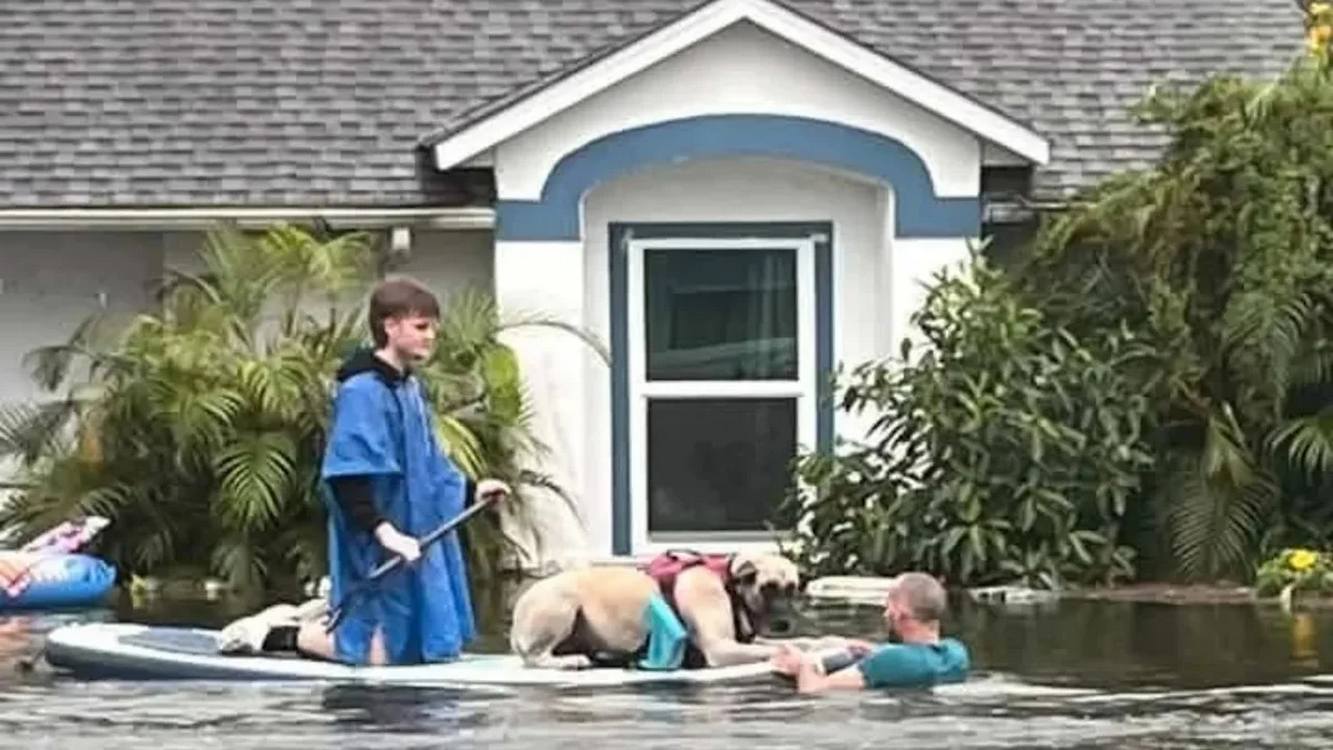
Photo: Brittany Grant via Facebook
When a thousand year rain event hit Brevard County, Florida last week, Brittany Grant and her son ended up sitting on their kitchen counter while floodwater rose over the floor. The 911 operator told her emergency services could not reach the house. She posted to Facebook asking for help.
Her neighbor Stephanie Fanguy saw the post and called her teenage sons. Jonah, 15, and Lucas, 17, grabbed an inflatable paddleboard and a borrowed kayak and set out. They reached Grant's house, coaxed her anxious son Nikoa out through a kitchen window, and ferried him, his mom, and all three of their dogs to safety. One of the dogs, Grant said, took up half the paddleboard.
Lucas spent the trip asking Nikoa, who struggles with anxiety, simple questions and joking about the weather. The water in the street was chest high. The boys got everyone home, and then they kept going. By the end of the day neighbors had organized airboats, kayaks, and improvised rafts across Palm Bay. A separate rescue down the block carried out an eighty year old man recovering from open heart surgery and a neighbor with ALS. Those teams included Florida Fish and Wildlife officers, volunteers, and anyone within reach of a boat.
"The community came together and saved us," Grant said. "If it wasn't for them, I don't know how we would have gotten out. My faith in humanity has been restored."
We're going to remember this one for a while. Two kids, one paddleboard, zero hesitation. Read the full story at Good News Network.
🌍 More Good Today
California's most colorful snake gets its first homecoming
The San Francisco garter snake lives nowhere else on Earth. Red, blue, and orange stripes, found only in San Mateo County, protected by the Endangered Species Act since 1967, and down to perhaps a couple of thousand animals in the wild. This fall, for the first time ever, 62 young snakes raised through a collaborative head start program at the San Francisco Zoo were released back into carefully chosen wild sites. Biologists had collected pregnant females in 2025, raised the babies to a size that gave them a fighting chance, and gene tested each one to route it to the population that needed its genetics most. Another 130 snakes are already growing at the Zoo for next year's release. San Francisco Zoo announcement.
A rare British butterfly booms 922 percent in one forest
In 2024, conservationists released 20 Wood White butterflies, a species classified as endangered in Great Britain, into Fineshade Wood in Northamptonshire. Last year's count there turned up 73 of them. This year's count: 746. That is a 922 percent increase from 2025, which Butterfly Conservation described as "absolutely extraordinary." A warm spring may have sped up caterpillar development, but the baseline fact is simpler: a careful, funded reintroduction worked. One volunteer counted 42 of the butterflies in a single July day. The Wood White's UK range had dropped 76 percent since 1992, and now this one forest is giving some of it back. BBC News coverage.
Lab raised axolotls are surviving (and gaining weight) in Mexico City's wetlands
The axolotl is critically endangered, with as few as 50 adults left in the wild in its only home, the canals and wetlands outside Mexico City. Scientists released 18 captive raised axolotls into two Mexico City wetlands, surgically fitted them with tiny trackers, and waited. Six weeks later, all 18 were still alive. When researchers recaptured two of them and weighed them, both had put on weight. One female had gained about two thirds of an ounce, more than a quarter of her starting body weight. The next question is whether they'll breed in the wild. For now, a species many feared was lost is out there finding its own food. Earth.com has the study details.
🔬 Science of Joy: Thirty years of patience, one real result
For more than thirty years, researchers at Johns Hopkins Sidney Kimmel Comprehensive Cancer Center have pursued what sounded for a long time like science fiction: a vaccine that trains your own immune system to recognize and kill cancer cells. On November 11, that work reached a milestone. A phase 3 clinical trial of a personalized mRNA melanoma vaccine (made by Moderna and Merck, custom built from each patient's own tumor) showed that patients who received the vaccine combined with standard immunotherapy had a recurrence free survival rate of 82 percent after two years, compared to 70 percent for immunotherapy alone. Distant metastasis free survival rose from 80 percent to 89 percent.
"Vaccines have been among the most transformative advances in modern medicine," Dr. Mark Yarchoan wrote in an accompanying editorial in the New England Journal of Medicine. The same Hopkins team is now running early trials of vaccines designed to prevent pancreatic cancer in high risk patients before it ever develops. We don't throw around the word breakthrough lightly. This is one. Johns Hopkins announcement and JAMA write up of the trial data.
💛 Bright Find
Sponsor spot
This spot is open, and we're picky about it. Great News Day readers are the kind of people who look for things that make the world a little kinder and a little more interesting. If you make a product or run a company that fits that bill, we'd love to hear from you. Just hit reply.
And if you're a reader with a favorite small business, charity, or indie creator we should know about, tell us. Some of our favorite finds have come from you.
✨ One More Smile
In a single limestone cavern in Death Valley National Park lives a fish that exists nowhere else on Earth. The Devils Hole pupfish. About an inch long, iridescent blue, living in water that hovers around 93 degrees Fahrenheit in the hottest, driest place in North America. Last fall, National Park Service divers and surface counters tallied 69 of them. Last week they counted again. 137.
"While challenges remain, we're encouraged by this progress," Death Valley Superintendent Mike Reynolds said. The total number of Devils Hole pupfish in the entire known universe has doubled in a year. Not bad for one little fish in one little cave. Environment America has the count.
See you tomorrow.
Keep looking for the good. It's looking for you too.
Great News Day
Reply