- Great News Day
- Posts
- Great News Day: October 7, 2026
Great News Day: October 7, 2026
In partnership with

Silver Miners Have Outrun Silver Since 2020

Since March 2020, silver has returned about 402%. The silver miners returned 445%.
That gap is the leverage our research team focuses on. When silver rises, a producer's net asset value can rise much faster, and share prices tend to follow. It works in both directions, and a mine is only as good as the company running it.
The Ultimate Silver Playbook shows how the team separates the miners worth owning from the rest, and which silver stocks are on its watchlist now. It's free.
Good morning, friend. Today's issue is held together by a quiet idea: that the small decisions we make to help often outlive the moment they took. A teacher scrolling Facebook. A 16 year old who paid attention in CPR class. A custodian walking into a classroom. All of them said yes to something small. All of them are, this week, the reason someone else is alive.
Let's dig in.
🌱 Today's Mindset
What one small yes becomes
Most of the kindest things that have ever been done to you were, at the moment they were decided, small. Somebody said yes to a thing they could have said no to, and the yes was quick. Fifteen seconds. A text sent. A box checked. A hand raised in a room.
It almost never feels, in the moment of saying yes, like the thing you are about to spend years inside. The nurse who first noticed. The teacher who stayed late. The friend who answered at 1 a.m. None of them were making a vow. They were just answering what was in front of them.
And yet, from the receiving end, those yeses are the ones that get carved into you. You remember them for the rest of your life. You tell your children about them. They become part of how you understand what people are capable of.
Here is what the pattern seems to be. A small yes, offered honestly, grows. It grows past what the giver expected. It grows past what the receiver could have asked for. Months later, years later, the yes is still unfolding, still arriving in a form no one planned.
Which means a lot of the good you will do today, you will not recognize as good. You will do it quickly, without ceremony, and then move on to the next thing on the list. Someone else, somewhere, will carry it forward in a way you may never see.
The small yes you say today may be the sentence someone writes about their life in twenty years.
⭐ Today's Bright Lead
A teacher saw a Facebook post. A 14 month old got a new liver.
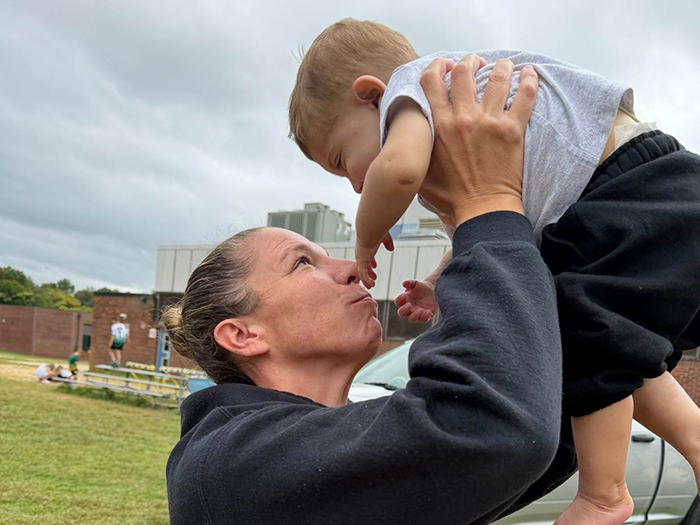
Courtney Olsen holds CJ Fischetti, the toddler whose life she saved through a liver donation. Photo: Fischetti Family via Toms River Regional School District.
Courtney Olsen was scrolling Facebook when she saw a post from two parents in her town looking for a liver donor to save their baby. She thought about her own kid. Then she opened the organ donor registration page and started filling it out.
Olsen is a teacher at Toms River High School South, in New Jersey. The baby was 14 month old CJ Fischetti, born with Alagille syndrome, a rare condition that attacks the bile ducts in the liver. CJ's parents, Leanna and Chris, are both alumni of the same Toms River school district. They had been searching for months for someone who could meet the medical and compatibility bar to be a living liver donor.
"As a parent myself, I knew what I hoped anyone would do for my child," Olsen told Jersey Shore Online. "Given my blood type and overall good health, I figured I would give it a shot. And thank goodness I did."
On August 6, CJ got his transplant. Both his surgery and Olsen's donor surgery were successful. CJ now proudly calls himself a member of the "New Liver Club," and he and Olsen are, in her words, "liver buddies for life."
The two met in person for the first time weeks later, by accident, at a flag football game on September 19. Olsen looked over and there was CJ, smiling, his transplanted liver doing its job. His uncle Ed, also a teacher in the district, summed it up: "Two separate Toms River families are now united as one because one TR teacher chose to become a lifesaver."
Source: Jersey Shore Online.
🌍 More Good Today
The 16 year old who remembered her CPR class
Elyria, Ohio
Mahogany Milton learned CPR a couple of years ago at an American Heart Association event. She did not expect to use it. Then her mother, B'Lon Calloway, went into cardiac arrest at home. Doctors would later find a 99 percent blockage. Mahogany, now 16, stepped in and did chest compressions until help arrived. Her mother is alive. This week, in front of hundreds of her peers at Cleveland's STEM Goes Red event, the AHA gave Mahogany its Heart Saver Hero Award. "She stepped in and her bravery is why I'm here today," Calloway said. Her daughter put it simpler: "This changed my whole perspective on helping people. I feel like my light is shining." (Cleveland 19 / WOIO)
Baby corncrakes caught on camera for the first time ever
Rathlin Island, Northern Ireland
Corncrakes used to be everywhere across Northern Ireland. Changes in farming in the 1980s nearly ended them, and they became one of the country's rarest breeding birds. This summer, four male corncrakes were heard calling on Rathlin Island, a small island off the Antrim coast. This week came the real news: wildlife cameras caught the chicks. At least three broods have been identified. It is the first time ever that corncrake chicks have been photographed on Rathlin. "It's a fantastic milestone for Rathlin and a reminder that conservation works when communities come together to give nature a home," said RSPB NI conservation officer Anne Guichard. (Belfast Telegraph)
Kiwi are back in the hills around Wellington for the first time in 150 years
Wellington, New Zealand
For a century and a half, there were no kiwi in the hills around New Zealand's capital. Through the Capital Kiwi Project, led by iwi, landowners, and local volunteers, more than 250 of the beloved national birds have now been returned to the Wellington landscape. Preparing the hills meant setting 5,300 traps across roughly 24,000 hectares to clear out stoats, the main threat to young kiwi. More than 90 percent of newly hatched chicks have reached a safe weight, and the local wild population is now estimated at more than 300. Project founder Paul Ward said the whole thing rests on three legs: the relationships with iwi, with communities, and with landowners. Pull one leg off, he said, and the tripod falls over. All three are holding. (National Indigenous Times)
🔬 Science of Joy
Twelve people with Type 1 diabetes. All twelve, off insulin.
In a small clinical trial at UChicago Medicine, every one of 12 adults with long standing Type 1 diabetes stopped needing insulin injections after receiving a transplant of donor islet cells paired with an experimental anti rejection drug called tegoprubart. The group had lived with the disease for an average of 33 years. Their blood sugar is now stable without insulin. The longest followed patients are more than 22 months in and still off their injections.
The procedure itself is minimally invasive: surgeons inject donor islet cells, the pancreas cells that produce insulin, into the liver under local anesthesia. The new piece is the drug. Earlier versions of this transplant worked at first for most patients and then faded, in part because standard anti rejection drugs are hard on the body. Tegoprubart, developed by Eledon Pharmaceuticals, is designed to protect the transplanted cells without that toll. Across all 12 patients, researchers reported no rejection episodes through the follow up window.
Doctors are being careful with the word cure. The trial is small, non randomized, and the real test is whether the cells keep working years from now. A larger study is being planned. But as of this week, 12 people who had spent decades counting carbs and watching glucose numbers are living without insulin shots, and the cells inside them are doing the counting themselves.
Source: NBC News, with trial results from UChicago Medicine and Eledon Pharmaceuticals.
💛 Bright Find
Sponsor spotlight
This spot is open... and we're picky about it. If your company makes something you'd actually want a friend to know about, reply to this email. We only run things we'd stand behind in person.
Not a dodge. A promise.
✨ One More Smile
A Boston school custodian named Andrew Allen heard that the brother of a teacher at his school, Thomas Thermidor, needed a kidney transplant. Allen signed up to donate. He wasn't a direct match for Thermidor's brother, but giving his kidney to the national pool moved the brother up the transplant list and saved another stranger too. On Friday, on National Custodian Day, the Boston Arts Academy honored Allen with its Unsung Hero Award. Allen and Thermidor hugged in front of the whole school. "Today, we celebrated the power of service, generosity, and community," the academy wrote.
A custodian walked into a classroom one morning. A stranger across the country has a kidney now. That is one small yes, still unfolding.
That's the day, friend. Say the yes.
See you tomorrow,
The Great News Day Desk
Reply