- Great News Day
- Posts
- Seven teenagers, one stalled car, one perfect team
Seven teenagers, one stalled car, one perfect team
Happy Wednesday, friends.
Today's issue leans on something we don't talk about often enough: the small act of looking up. Seven teenagers on a Massachusetts road, a woman at the top of a stairwell in Texas, 150 neighbors in a Vermont village. None of them planned to be somebody's story. They just noticed. Grab your coffee. This one's a good one.
🌱 Today's Mindset
The kindness engine starts with a glance
Most of the goodness that reached somebody today did not start with a plan. It started with a glance. Somebody looked up from their own errand, saw a stranger who needed a hand, and decided to be the person who acted instead of the person who kept walking.
That is such a small thing. It is not sainthood. It is not heroism. It is the two-second choice to keep your head up in a world designed to keep it down. The phone in the pocket. The route home you have taken a thousand times. The rush from one obligation to the next. All of it quietly trains us to move through the day with our eyes half closed.
And yet noticing is the whole engine. The teenager who saw a stalled car. The neighbor who saw an 81 year old struggling with a suitcase. The fishermen who saw a trunk poking out of a river like a periscope. None of them needed a special skill. They needed a single second of attention.
Here is what is quietly wonderful about that. You already have this capacity. It has been with you the whole time. Maybe today you get to use it. Maybe you spot the person who dropped a glove, or the coworker whose shoulders are a little heavier than usual, or the driver behind you who needs to merge. You do not have to change your life. You just have to keep your head up.
Every day the world is quietly full of people waiting to be noticed. And now, you might be the one who does.
⭐ Today's Bright Lead
Seven high school seniors, one stalled car, one perfect team
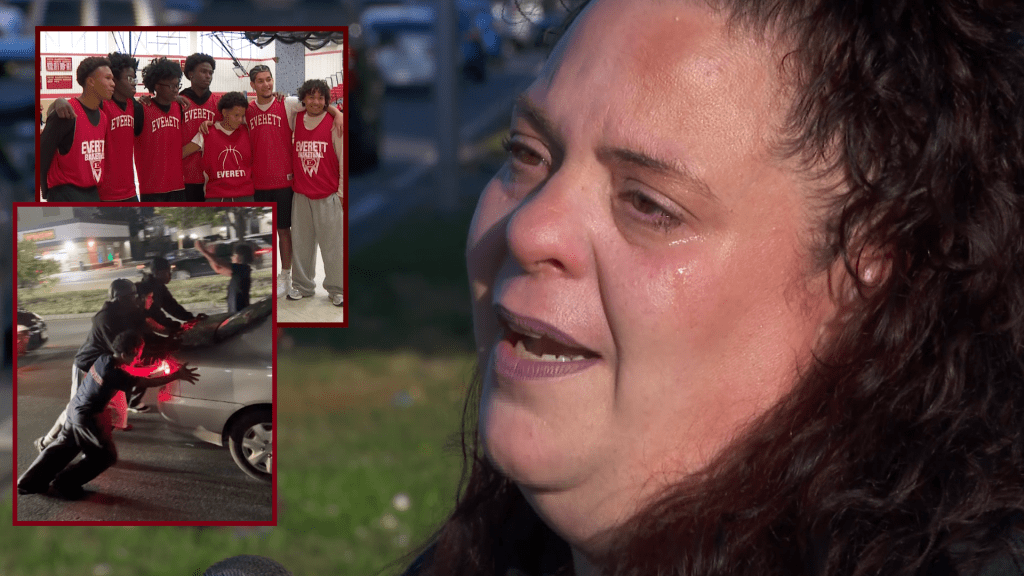
Image: WBAL Baltimore / Everett High School athletes
Robin Gay had just finished a volunteer shift at a dance studio in Everett, Massachusetts when her car died in the middle of Revere Beach Parkway. Traffic was flying past. She went straight into panic. Her one thought, she said, was that somebody was about to hit her.
Then seven teenagers, all Everett High School student athletes, spotted her from across the road. They did not stop to talk about it. They crossed. Senior Raul Guimaraes said it out loud for the group. "She's stuck in the middle of the road. Let's help her."
They had her steer while they pushed. One student stepped into the roadway to wave oncoming cars around. Senior captain Jayden Alsaindor pulled out his phone to record it, not for likes but because he wanted the memory. "You cannot ask for a better team than this," you can hear him saying on the video.
When they got her car safely into a parking space, Gay tried to hand them money. They wouldn't take it. They pushed her hand away, gave her a hug, and told her they were just glad she was safe. When asked whether they would do it again, senior Emmanuel Nelson answered for all of them. "If we saw it again, we would just go do it again."
Senior Emmanuel Lerbout added the line that stuck with us. "It doesn't matter if you don't know the person. If you see someone in trouble, just go help."
Read the full story at WBAL Baltimore
🌍 More Good Today
Vermont villagers move a library by hand, book by book
Middletown Springs, Vermont: about 150 neighbors lined up in a human chain earlier this month and passed thousands of books, hand to hand, from the town's 48 year old library into its brand new home two doors down. To keep the shelves organized, volunteers used a color coded system of green and red blocks to signal where each genre section began and ended. A local brass quintet played while they worked. The whole reshelving took three hours. "This morning it wasn't a library, and now it's a library," said assistant director Haley Kenyon when the last book slid onto a shelf. "We did it."
A calf swept downstream, a trunk like a periscope, and five fishermen who chased it
West Bengal, India: a four day old elephant calf was crossing the Teesta River with its herd on Monday when the current pulled it away. It floated nearly three miles downstream, its little trunk raised above the water like a periscope so it could breathe. Five local fishermen in a small dinghy chased it, following the current with bamboo staves for oars, until they caught up and lifted the calf onto the boat. Forest officials brought it back upstream and set it on a dry stretch of riverbed. Within minutes the calf called for its mother. She emerged from the tall grass, rumbled once, and wrapped her trunk around it.
Four seals, one closed dry dock, and a rescue team that waited them out
Cape Town, South Africa: four Cape fur seals slipped into a pitch black tunnel inside the city's Sturrock Dry Dock and got stranded behind 14 meter walls when the gates closed for ship maintenance. The Two Oceans Aquarium marine team spent three weeks coaxing them out. They played recordings of seal calls to lure them from the tunnel. Two seals had to be carried out in nets, up several flights of stairs, back to the harbor. The third simply climbed the four flights on its own and released itself into the water. The fourth swam calmly out as the dock refilled. All four are home.
🔬 Science of Joy
The human brain, it turns out, is two organs that learned to work together
Here is a delightful reframe of something you have been carrying around your whole life. Stanford researchers published a study on Tuesday in Nature Neuroscience showing that the human brain is not one organ but two: a front and a back, which arise from completely different cellular starting blocks in the earliest days of a growing embryo, and only later fuse into what feels like a single thinking machine.
The scientists made the discovery by trying to solve a long standing puzzle: cells from the back of the brain were nearly impossible to grow in a dish, while cells from the front grew easily. That mismatch turned out to be the clue. Front and back come from separate lineages, hardwired from the very beginning, with genetic instructions packaged in completely different ways.
The team even found the same two part design in acorn worms, which share a very distant ancestor with humans. That suggests the arrangement dates back roughly 500 million years. Even better: now that they know how to grow those back of brain cells in a lab, researchers can begin building new models for diseases like ALS and spinal muscular atrophy that specifically target the lower brain's motor neurons. A puzzle that looked like an inconvenience turned out to open a door.
💛 Bright Find
Sponsored slot, open today
This spot is open today, and we're picky about it. Bright Find only ever features things that fit the sunshine you come here for: a small business worth knowing, a book worth reading, a product our readers would genuinely love. If that sounds like something you make, we'd love to hear from you. Just reply to this email.
✨ One More Smile
A kindergarten class in Kansas City threw a surprise birthday party this week for the woman who reads to them a few times a month. Her name is Eileen McKeon. She just turned 93. The kids sang, presented cards drawn in crayon, and when Eileen realized what was happening, she cried. So did most of the teachers. So, honestly, did we, watching NBC's clip of it.
Ninety three years old, and still choosing to spend her mornings on the reading rug with a room full of five year olds. There is a whole life philosophy in that.
Keep your head up out there today. You never know who is waiting to be noticed.
With sunshine,
The Great News Day team
Reply