- Great News Day
- Posts
- Hillsboro rolled 80 trucks into his beet field, and told him to rest
Hillsboro rolled 80 trucks into his beet field, and told him to rest
Plus 21 Kenyan widows tending a mangrove nursery, four cheetah cubs born at Kuno, and a small wild cat that was hiding in plain sight for a hundred years.
Good morning. Today's issue starts in a beet field in North Dakota and ends with a small wild cat that was hiding, in plain sight, for a hundred years. In between: sewing machines, cheetah cubs, Kenyan widows tending a mangrove nursery, and two little girls in St. Louis who woke up in separate beds for the first time in their lives.
Pour something warm. You'll love this one.
🌱 Today's Mindset
The debt that isn't a debt
There is a version of accepting help that feels like taking on debt. Somewhere along the way, most of us learned that receiving is the shameful half of the exchange, that self‑sufficiency is the goal, and that anyone who lets a neighbor rescue them is somehow less than the neighbor doing the rescuing.
But if you watch how it actually moves through a real community, that math falls apart. Nobody in Hillsboro, North Dakota is keeping score this week. The farmer bringing in a neighbor's beet harvest is not adding a line to a ledger. He is settling into a rhythm that has always been running through that town, one that says the tractor comes out when the tractor is needed, and whose tractor it is doesn't matter very much.
Here is what most of us miss. Communities are not built by the people who never need anything. They are built by the people who let themselves be helped, because that is how they teach everyone around them that it is safe to ask.
If you have spent this year quietly keeping your own house upright, spending yourself outward and refusing everything that came back the other way, notice that you may be starving the very people who love you most. They want a way in. Give them one.
Today, let one small thing come to you. Say yes to the coffee somebody offered to pay for. Take the ride. Answer the phone when the neighbor calls to ask if you need anything and, instead of "we're fine, thanks," try "actually, could you..."
You are not becoming a burden. You are keeping the current alive.
⭐ Today's Bright Lead
Hillsboro rolled 80 trucks into his beet field, and told him to rest
Valley News Live / KVLY, via Gray News.
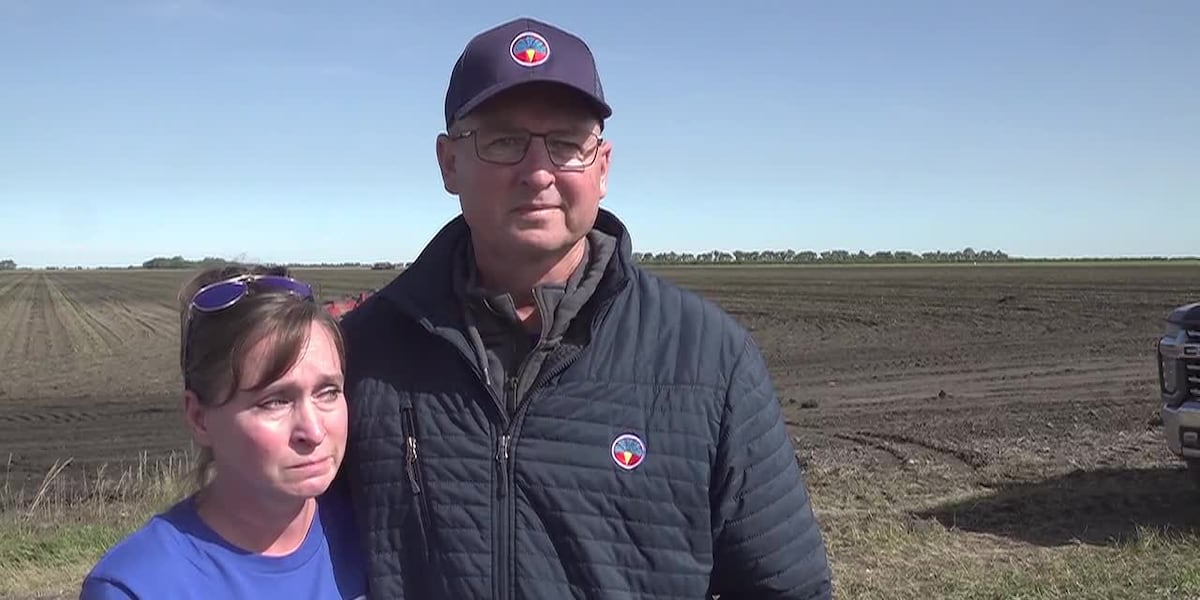
Bill Cotton has farmed outside Hillsboro, North Dakota his whole life. Father of five. The kind of neighbor who shows up. This spring, at 55, he was diagnosed with stage 4 brain cancer, and the summer disappeared into treatment schedules and hospital rooms and a growing worry at the back of the family's mind: the beets. If the crop didn't come out of the ground, the year was gone.
On Wednesday, the neighbors answered the beets.
Farmers from around Hillsboro rolled into Cotton's field with an estimated 70 to 80 trucks and multiple harvesters, volunteering equipment and time to pull his crop for him. Trucks lined the edge of the field. The harvesters moved row by row. Bill's brother Greg watched it happen and said what everybody in a small ag town knows: "Anything in the community, or people who need help, Bill is always the one to step up and help. It's just really neat to see everybody come out here and help him this time."
Cotton's chemotherapy is expected to continue for three more months. Doctors don't know how much time he has. But on Wednesday, the clock belonged to the fields, and to the people who showed up.
"All of a sudden, it dawns on you that everybody is here," Cotton said, "and it shows how good they are."
Read the full story at KTRE / Valley News Live →
The family has also started a GoFundMe for his medical expenses; the link is at the bottom of the KTRE article above.
🌍 More Good Today
The Ohio women sewing zippers into chemo shirts, 7,000 a year
Pat Cochran started with three T‑shirts. Her friend Dennis was going through chemo and couldn't wear his own clothes to appointments; the nurses needed to reach the port under his collarbone. So she sewed a zipper across the chest of three shirts. He wore them to every treatment.
Almost a decade later, Cochran leads more than 50 seamstresses across five southwest Ohio counties, plus a "Snowbird chapter" that operates out of Florida each winter and satellite groups in Wisconsin and Indiana. Together they turn about 7,000 shirts a year into zippered chemo shirts and hand them, for free, to cancer treatment centers around the state. Each one goes out with a card, so the patient knows a stranger is rooting for them.
"There's not a lot of joy to be had in infusion centers," said Sheila Sennet, whose husband wore his blue zippered shirt to every appointment. "But that shirt sure made Dan's day." Ohio Newsroom →
India: four cheetah cubs, and a species that came back
The cheetah was declared extinct in India in 1952. In 2022, eight cheetahs were flown in from Namibia to Kuno National Park in Madhya Pradesh, followed by more from South Africa, and India became the only country to try to reintroduce the world's fastest land animal into the wild after local extinction.
This week, a female named KGP12, an Indian‑born cheetah born at Kuno, gave birth to four healthy cubs. Second‑generation births in the wild are the metric wildlife biologists actually watch, because they mean the reintroduced population is starting to make itself at home. Project Cheetah has had setbacks. It has also, four years in, produced a mother born on this soil raising a litter of her own in the grass.
The park's monitoring team calls it what it looks like: a milestone. India Today →
Kenya: 21 widows, one estuary, and a mangrove that came back too
On the Athi‑Galana‑Sabaki River in Kilifi County, a group of 21 women, all widows living near the estuary, run a mangrove nursery. They call themselves the Patanani Wito Women Group. A stretch of coast that used to be stripped for quick cash by illegal loggers is now a working conservation zone, with a boardwalk, a bird hide, and a restaurant the women operate for visiting tourists.
Elina Damacharo, 57, joined the group in 2011 with seven school‑age children and no way to feed them. Most of those children have now finished their education. She runs the group's seedling nursery, keeps goats, and has replaced the grass‑thatched hut her husband left her with an iron‑roofed house.
The Sabaki River Estuary is now recognized as one of Kenya's 68 Key Biodiversity Areas, hosting more than 240 bird species. "The group gave me a job," Damacharo said. And then a life. Xinhua via The Star →
🔬 Science of Joy
Hiyab and Wuhbto woke up in two beds
Hiyab and Wuhbto were born in Ethiopia two years ago as craniopagus twins, joined at the tops of their heads and facing opposite directions. The condition is one of the rarest in medicine, roughly one in 2.5 million births. Only 62 separation attempts have ever been documented worldwide.
Through a global partnership with the World Pediatric Project, the girls traveled to SSM Health Cardinal Glennon Children's Hospital in St. Louis before their first birthday. Over the following year, surgeons ran a series of preparatory operations, slowly untangling shared blood vessels and expanding skin so the final separation could happen without cutting off blood to either brain.
The final surgery began on the morning of February 24 and stretched a full 24 hours. Dr. Joanna Kemp, associate professor of neurosurgery at Saint Louis University, led the team. In doing so she became the first woman neurosurgeon in American history to complete a craniopagus separation.
Weeks after the surgery, the girls turned two. For the first time in their lives, they rested in two separate hospital beds. Wuhbto has already had her skull reconstruction surgery; Hiyab is scheduled for hers this fall.
SSM Health → · KMOV via Gray News →
💛 Bright Find
Sponsor slot
This spot is open, and we're picky about it. If your company makes something we would actually recommend to a friend, we would love to hear from you. Reply to this email and say hello. The right reader is here, and we would rather introduce them to the right thing than fill the space.
✨ One More Smile
A small wild cat was hiding, in plain sight, for a hundred years

Reuters.
In the cloud forest on the eastern slope of the Andes in Bolivia, there is a small wildcat that local communities have always known. They call it Tilcayo. It is about 18 inches long, weighs around three pounds, smaller than the average house cat, and it lives in a band of humid, largely under‑studied cloud forest called the Yungas.
This week, in the journal Current Biology, an international team of researchers announced that Tilcayo is a species entirely new to science. Leopardus tilcayo. The first new wildcat species formally named and described in more than a century. The last time this happened, it was 1923.
The world is still handing us gifts, and it is not finished yet.
Have a beautiful Friday. Say yes to something small today. Let somebody carry a little of it for you.
See you tomorrow,
Great News Day
Reply