- Great News Day
- Posts
- The neighbors in Tok are racing winter, and winning
The neighbors in Tok are racing winter, and winning
Thursday, August 28 · Great News Day
Good morning, friends.
Today's issue is quietly about preparation. About the people who kept a tradition alive so it was ready when their neighbors needed it. Grab your coffee. We're glad you're here.
🌱 Today's Mindset
The quiet homework of love
Most of the stories that will make you cry this year are going to feel spontaneous. A stranger dove in. A neighbor showed up with a truck. A kid ran for help.
They will not actually be spontaneous. They will be the visible edge of a long, quiet practice.
The Alaskan volunteers you'll read about below are building winterized shelters this week because Alaska has been building winterized shelters for a hundred years. Somebody's father learned it from somebody's grandfather. When the emergency arrived, the skill was already in the room.
Big warm-hearted moments look like miracles. They are almost always inherited. Somebody, quietly, kept a tradition alive. Somebody kept a phone tree updated. Somebody stayed friends with the neighbor across the street long after there was any obvious reason to.
Here is the reframe. If you want to be the kind of person other people can lean on in a hard moment, you cannot audition for it in the hard moment. You have to be it in the boring one.
Boring, in this sense, is a compliment. It means keeping the shelf stocked. It means texting back the friend who is easy to forget. It means remembering the birthday. It means saying yes to the tenth invitation, because that is what keeps you inside the fabric.
The saints of your local newspaper are people who did the small, unglamorous work of showing up for years. They did not become heroes on the day they were needed. They became reachable, well before.
So today, do one small unfashionable act of readiness. Salt a walk. Send a text. Learn a neighbor's name.
The list of people who will thank you for it later is longer than you think.
⭐ Today's Bright Lead
The neighbors in Tok are racing winter, and winning
Tok, Alaska
Community donations gathered inside the Tok School. Photo courtesy of local coverage.
The Mukluk Fire has burned through more than 7,000 acres of interior Alaska and taken 44 structures with it. In a town of a few thousand people, that is not an abstraction. Every family knows who lost what.
Here is what the town did next. A group of neighbors decided that no one who lost a home was going to face an Alaskan winter without a warm place to sleep. So they picked up their tools.
Their plan is to build 15 to 16 insulated arctic shelters over the next two weeks. Every person swinging a hammer is a volunteer. Project coordinator John Rusyniak explained the reasoning simply: last winter Tok saw 75 below zero, and more than 50 days of extreme cold. "We want to make sure people had a warm structure," he said.
Meanwhile the Tok School has been converted into a donation center. Sorted piles of clothing, books, DVDs and personal items line the halls. The American Red Cross of Alaska and the Salvation Army Alaska Division are on the ground handing out cards so displaced families can buy what they actually need. Groups from all over the state have driven supplies in.
"There's been a tremendous outpouring of generosity," one state emergency official said. Which is a wonderful sentence. And also, if you know Alaska, a completely expected one.
🌍 More Good Today
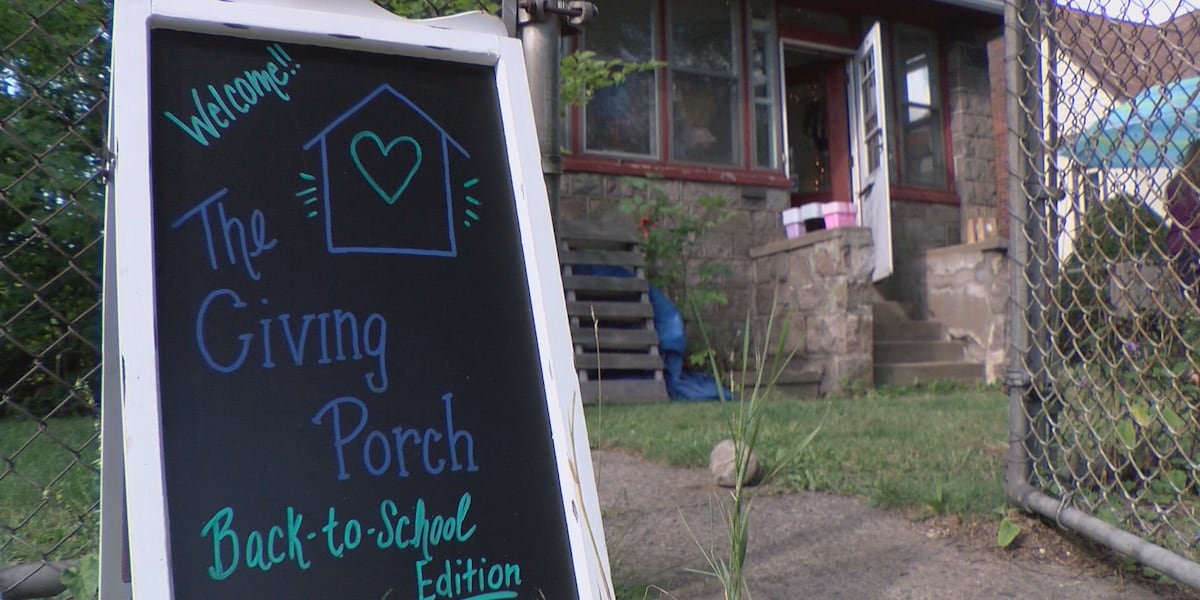
A porch in Minnesota became a back-to-school store
Virginia, Minnesota
Marie Domiano's front porch on the Iron Range spent this week lined with backpacks, racks of clothes, and school supplies. Families made appointments. Kids picked out what they needed for the year. Everything was free.
Domiano started the "Giving Porch" last Christmas with donated toys and clothes. It has now reopened for the school year, stocked by community donations and Domiano's own contributions. "The joy of giving is just kind of what energizes us to be able to pull it all off," she said.
Costa Rica's forest just welcomed 13 travelers home
Piedras Blancas National Park, Costa Rica
Eighteen years ago, hunters wiped white-lipped peccaries out of Costa Rica's Osa Peninsula. This month, 13 of them were reintroduced to Piedras Blancas National Park after a careful captive-breeding and monitoring program.
These small forest pigs are what ecologists call a keystone species. They churn the soil with their snouts, disperse seeds, and dig wallows that hold water for every other animal in the neighborhood. Bring the peccaries back, the theory goes, and the forest itself starts to heal.
The platypuses remembered exactly where they lived
Tidbinbilla Nature Reserve, Australia
When drought dried up their creek near Canberra, Australian scientists made an unusual call: they pulled seven platypuses out of the wild and kept five of them safe in captivity for about five months. Nobody knew whether they would readjust once they went home.
They readjusted in a matter of days. Once released back into the reserve, the platypuses reclaimed their old home ranges and resumed normal movement patterns almost immediately. It is a small, hopeful data point for climate-era wildlife rescue: sometimes you can hold an animal safe through the worst season, and the wild will still be waiting.
🔬 Science of Joy
A first, real crack in pancreatic cancer
United States
Pancreatic cancer has been one of the most brutal words in medicine for as long as most of us have been alive. This week, the FDA approved a drug that appears to genuinely move the needle on it.
The drug is daraxonrasib, brand name Rasonque, from Revolution Medicines. It targets a mutated form of a protein called KRAS that drives the majority of pancreatic cancers, a target researchers have been chasing for decades. In clinical trials the drug improved survival compared with existing options. It is the first therapy of its kind approved for pancreatic cancer.
This is not a cure, and no one is calling it one. It is something almost as valuable: a first foothold on a mountain no one had climbed. Families who have watched loved ones lose this fight will understand what a foothold is worth.
💛 Bright Find
Sponsor slot
This spot is open... and we're picky about it.
Great News Day only recommends products, books, and small businesses we would send our own families to. If you make something you would be proud to put in front of thousands of good-hearted readers, we would love to hear from you.
Just hit reply. A real person reads every note.
✨ One More Smile
A Bengaluru auto driver became a human tow truck
A woman in Bengaluru's traffic broke down on her scooter this week. An auto-rickshaw driver named Tanzeem saw her, pulled up beside her, and for the next 10 to 15 minutes drove alongside her scooter with his bare foot pressed against it, pushing her to safety.
The whole thing was filmed by another commuter. The video's still going around the internet, mostly because everyone who watches it needs to know one thing: he refused to take any money afterward.
That's your batch of good today. Thanks for reading, for forwarding, and for being the kind of person who wanted a mailbox full of this.
See you tomorrow morning,
The Great News Day team
Great News Day is a daily brief of verified uplifting news.
Reply to this email any time. A human reads every note.
Reply