- Great News Day
- Posts
- We're back... and Great News Day looks different now
We're back... and Great News Day looks different now
A mindset reset, a one-in-100,000 kidney, and the world's first solar-powered ambulance.
☀️ Great News Day
We're back.
And we've got something better.
Saturday, August 15, 2026 · The Relaunch Issue
Hello, friend. It's been a while.
Fourteen months, if we're counting... and you probably were. No excuses offered. Life got loud, this letter got quiet, and somewhere in there the thing we built together went still. If you unsubscribed in the meantime, you had every right. If you stayed, thank you. Genuinely.
Here's what we've learned in the silence: the world did not get less good while we were gone. It got less reported. Every single day, somewhere, a stranger is doing something for another stranger that would restore your faith entirely if anyone bothered to tell you about it. Almost nobody bothers.
So that's the job now. Every day. Starting today.
What Great News Day looks like now
🌱 A mindset moment first. Same as always... one honest thought to carry into your day. That part isn't going anywhere.
📰 Then five real stories. Verified, sourced, linked. Mostly American, with the best of the wider world mixed in, because good news shouldn't stop at the border.
🚫 No politics. No religion. Ever. Not a dodge. A promise. This is the one inbox that stays a demilitarized zone.
⏱️ Five to seven minutes. Daily. Short enough for coffee, real enough to matter.
That's the deal. If it's not for you, the unsubscribe link is right at the bottom and there are no hard feelings. If it is, pull up a chair.
🌱 Today's Mindset
The gap was never the failure.
There's a particular kind of shame that grows in a pause. You meant to write every day and then you didn't, and the not-writing became its own weight, and the longer it went the heavier the returning got. You know this feeling. Maybe not about a newsletter. Maybe about a gym membership, a half-finished book, a friend you've been meaning to call for so long that calling now feels like an apology.
Here's the reframe, and it's free: the gap was never the failure. Staying gone would have been.
Nothing you paused is disqualified from being resumed. The book doesn't care that you left it. The friend will almost certainly be glad. The version of you who stopped and the version who starts again are the same person, and that person is allowed to simply... begin. On an ordinary Saturday, without ceremony or a good explanation.
Whatever's been sitting still in your life while you worked up the nerve: today's a fine day for it. We'd know.
⭐ Today's Bright Lead
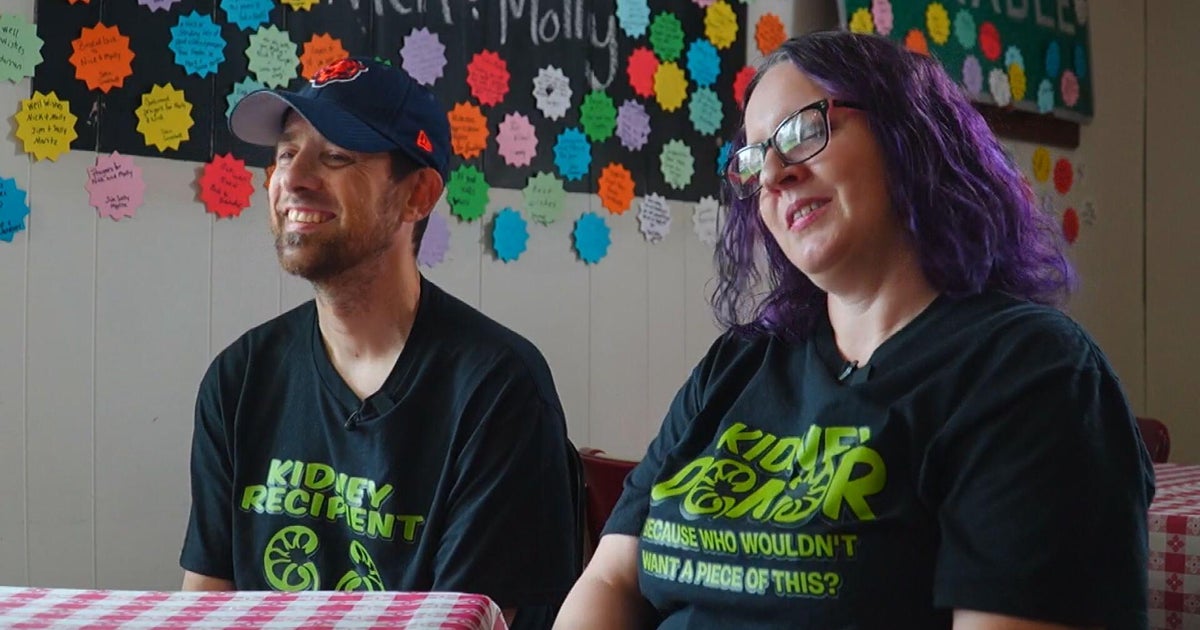
Photo: CBS Chicago
🇺🇸 The odds were one in 100,000. She lived one town over.
Nick Bohn, a restaurant owner in downstate Illinois, needed a kidney. He is not a man who asks for help, so his wife Lindsay asked for him. One Facebook post, put out into the world without much hope attached.
What came back astonished him. Messages from Indiana. From Florida. From Virginia. At one point a local reporter came to interview him about the search and mentioned, offhand, that his own wife had already signed up to donate. "I didn't even know the guy," Bohn said. "I didn't know her."
But the match wasn't in Virginia. Molly Clyden (wife, mother, self-described helper) lives in the next tiny town over. She saw the post that evening and didn't finish reading it. "I just read that he needed one, and I shot off a message right away."
She turned out to be a one-in-100,000 match. Not a sibling. Not a relative. A stranger down the road whose kidney fit like it had been waiting.
They had the surgery at Rush University Medical Center in late June: four hours, laparoscopic, no complications. Clyden wore a t-shirt reading "Kidneys are made to be shared." Her entourage included a stuffed dinosaur. Two weeks later Bohn's bloodwork was better than it had been with either of his originals.
"She's an amazing, awesome human being to want to do this for a stranger," Bohn said. "I will never be able to thank her enough."
Clyden has a simpler name for what they are now: kidney buddies for life.
Read the full story at CBS Chicago →
🌍 More Good Today
🇺🇸 Ohio: he posted his phone number, then cleared 80 yards.
When severe storms tore through Columbus on Tuesday, Sean Rogers Jr. did something slightly reckless. He put his personal phone number on Facebook and offered free tree and debris removal to anyone who couldn't afford it. The phone did what you'd expect. So he called in his father, his brother, and his five-year-old nephew, and they started working through the list with an excavator and chainsaws. By Thursday they'd cleared damage at nearly 80 homes. At Nancy Davis's place near Walnut Ridge, a downed tree that had loomed over her week was gone in ninety minutes. "Honestly I just really want to cry," she said. "Because somebody cared enough to come and do this for me. And you don't find that every day." He's still taking calls. ABC 6 →
🇰🇪 Kenya: the world's first solar-powered ambulance just hit the road.
It's called Stella Juva, and on a sunny day it can cover 715 kilometers without touching a drop of fuel. Twenty-three student engineers at Eindhoven University of Technology built it; Amref Health Africa helped shape it for the places it's actually needed. This week the students flew to Kenya to test it where it counts, running realistic medical scenarios across hard terrain through Nakuru, Kajiado, and Narok. The point isn't the novelty. In regions where fuel cost and grid access decide whether an ambulance rolls at all, a vehicle that runs on daylight is a genuinely different proposition. Citizen Digital →
🇲🇳 Mongolia: glaucoma care that no longer requires a 1,000-kilometer drive.
For roughly half of Mongolia's three million people, the nearest glaucoma service sat up to 1,000 km away, across terrain that freezes solid for months. For a disease that demands early detection and lifelong monitoring, distance isn't an inconvenience. It's how people go blind. Australian company Eyeonic, working with the charity Sight For All, has now put cloud-based visual field testing into 20 regional hospitals. No specialized hardware; any computer or tablet will do, and results reach specialists through the cloud. Up to 90% of glaucoma cases go undetected in some parts of the world. This is what closing that gap actually looks like. Insight →
🔬 Science of Joy
🇺🇸 They cracked the "undruggable" target. Pancreatic patients are getting it now.
For thirty years, the standard offer for advanced pancreatic cancer was intravenous chemotherapy and not much hope. Fewer than one in ten patients with Stage IV disease survive a full year.
Then came daraxonrasib, a pill that goes after RAS, a protein so long considered untouchable that oncologists used it as the textbook example of a mutation nobody could drug. In a 500-patient Phase 3 trial, patients who took it lived a median of 13.2 months versus 6.7 on chemotherapy alone. Roughly double. When the results were presented at this year's ASCO conference, the room gave the research team a standing ovation.
It is not a cure, and nobody involved is pretending otherwise. But it's moving fast: through an FDA expanded-access program, patients can now receive it before full approval, at Stanford, at Norton in Kentucky, and across ten Intermountain Health hospitals in Utah, Colorado, and Montana.
Dr. Mark Lewis of Intermountain put the significance plainly. Walking out of that conference, he heard colleague after colleague saying the same thing... now nothing is undruggable.
Christina Baumer, a 37-year-old Louisville mother of two, is taking it. She talks about it in the currency that actually matters: more family dinners. Another season of watching Jeopardy with her husband. More rounds of hide-and-seek in the backyard. "I think I've come to a point where I just realize all the time that I have can be meaningful," she said. "No matter how big or small the thing is that I'm doing."
💛 Today's Bright Find
This spot is open... and we're picky about it.
Each issue we'll feature one thing worth your attention: a product, a cause, a small business doing it right. It'll always be labeled, it'll always be something we'd tell a friend about, and it'll never interrupt a story to get your attention.
Want to be a future Bright Find? Just reply to this email.
✨ One More Smile
Somewhere in Milwaukee right now there is an envelope sitting on a coffee shop table, or tucked into a little free library, with two words written on the front: Open me.
Inside is a handwritten note from a woman named Katrina Lord, who has been quietly leaving them around the city since 2016. More than a thousand so far. One of them reads: "Happiness, not in another place, not for another hour, but this hour." On the back, in her own hand: "Hello, stranger! May you have happiness here and now." Two small hearts.
People write to tell her what finding one did for them. Some were having a hard day. Some read it as a message from someone they'd lost. "You get something like this," she says, "and you can interpret it as whatever you need it to be at that time."
See you tomorrow.
Same time, same warmth, no gap.
Yours,
The Editor · Great News Day
Know someone who could use one good email a day?
Forward this. It's how the tribe grows.
Reply